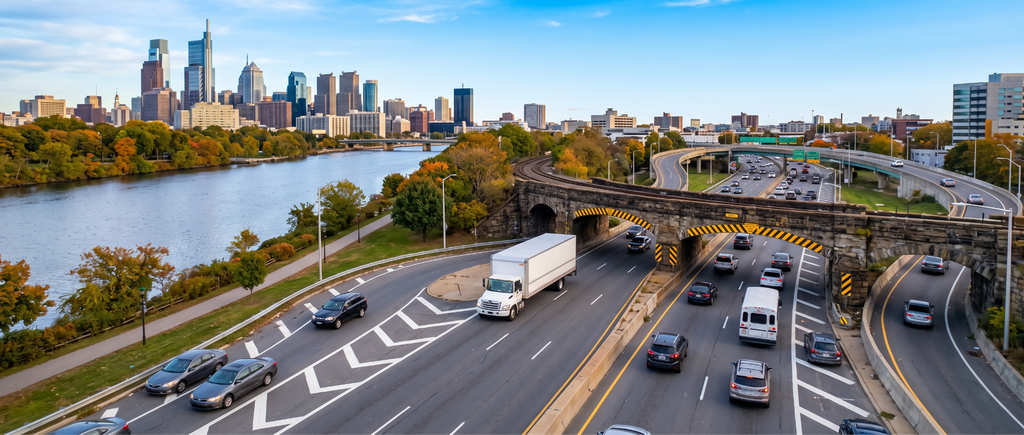
Students arriving in Boston from almost anywhere else encounter a road network that seems to have been designed by someone actively hostile to newcomers. That impression is close to accurate, though the hostility is historical rather than personal.
Boston’s streets predate the automobile by roughly two centuries, and the highways layered on top of them were built to standards that would not be approved today. Much of the network was fitted into space that already existed rather than designed from scratch, which is why lanes narrow without warning and exits appear where geometry allowed rather than where a driver would expect. Understanding which specific features cause the most trouble is genuinely useful for anyone driving here for the first time.
Storrow Drive: The Road That Eats Trucks
Storrow Drive runs along the Charles River with clearances low enough that box trucks and rental moving vans strike the overpasses regularly enough that locals have a name for it, “Storrowing,” which peaks every September 1 when the city’s leases turn over simultaneously.
Why is it dangerous beyond the obvious
The comedy of stuck trucks obscures the real hazards: lane widths narrower than modern standards, entrance ramps with almost no acceleration distance, and curves posted well below the speed traffic actually carries. Merging requires accepting a gap that would be considered inadequate on any road built in the last fifty years.
There is also no shoulder for much of its length, which means a breakdown or minor collision becomes a live-lane obstruction instantly.
Drivers who grew up on interstates built after the 1960s have never encountered a limited-access road with these dimensions. The instinct to maintain highway speed because the road looks like a highway is precisely the instinct that causes trouble here.
I-93 Through the City
The central artery carries an enormous volume through a tunnel system with a particular set of characteristics: closely spaced entrances and exits, weaving sections where merging and exiting traffic must cross paths, and left-side exits that violate the expectation nearly every driver brings from elsewhere.
The weave problem
When an on-ramp and an off-ramp are placed close together, every vehicle entering must cross the path of every vehicle leaving within a short distance. These weaving sections concentrate conflict points and produce a steady stream of sideswipe and rear-end collisions that have little to do with anyone driving badly.
Tunnel sections add a further complication. Drivers entering from daylight experience a brief period of reduced vision while their eyes adjust, and lane markings that read clearly outside become harder to track under artificial light. Exit signage arrives with less warning distance than an above-ground interchange would provide.
The Rotaries
New England rotaries are not modern roundabouts, and conflating the two causes crashes.
Modern roundabouts are small, slow, and yield-on-entry by design. Many older Massachusetts rotaries are large, fast, multi-lane, and have inconsistent or ambiguous yield conventions, with the added complication that right-of-way expectations differ between them.
Drivers who learned on modern roundabouts enter expecting predictable behavior and encounter something else entirely.
The lane-choice trap
The specific failure is choosing the wrong lane on entry. In a large multi-lane rotary, a driver who enters the outside lane intending to travel most of the way around must cross the path of exiting traffic to stay in the circle, and a driver in the inside lane wanting the next exit must cross traffic to leave. Both maneuvers happen at speed, in a curve, with limited sight distance, which is why sideswipes dominate the crash profile at these locations rather than the low-speed fender contact typical of modern roundabouts.
Where to Find the Actual Data
Impressions about dangerous roads are unreliable; documented crash locations are not. The City of Boston publishes crash and fatality records through its open data portal, including the Vision Zero crash records dataset, compiled from public safety dispatch data and updated regularly.
The city’s broader Vision Zero program sets out the safety strategy built around those records, which is the closest thing to an official map of where the network fails.
What Happens After a Crash Here
Massachusetts operates a no-fault system for initial medical costs, which surprises drivers from other states. Personal injury protection benefits under Chapter 90, Section 34M of the Massachusetts General Laws pay first regardless of who caused the crash, and are capped, which means serious injuries move outside that system quickly.
According to Christopher Steinhaus, an Associate Attorney in RTRLAW’s personal injury litigation division, the recurring problem in crashes on complex urban interchanges is that fault is genuinely ambiguous at the scene, and the police narrative written in fifteen minutes on a live highway often becomes the version everyone argues about for the next year. Because roadway geometry frequently explains a collision better than either driver’s account, Boston accident attorneys look at sight lines, merge distances, and signage at the specific location rather than accepting the report’s assignment of fault as settled.
Driving Here Without Incident
Accept that the network rewards familiarity and punishes hesitation. On Storrow, know your vehicle’s height before you enter and take the posted curve speeds seriously rather than as suggestions. On I-93, position yourself for your exit well in advance, because a missed left-side exit in a tunnel is not recoverable.
At rotaries, slow down, yield to traffic already circulating, and pick your lane before entering rather than after. And in general, leaving a following distance that feels excessive is the single most useful adjustment on roads where the vehicle ahead may stop for reasons you cannot see.