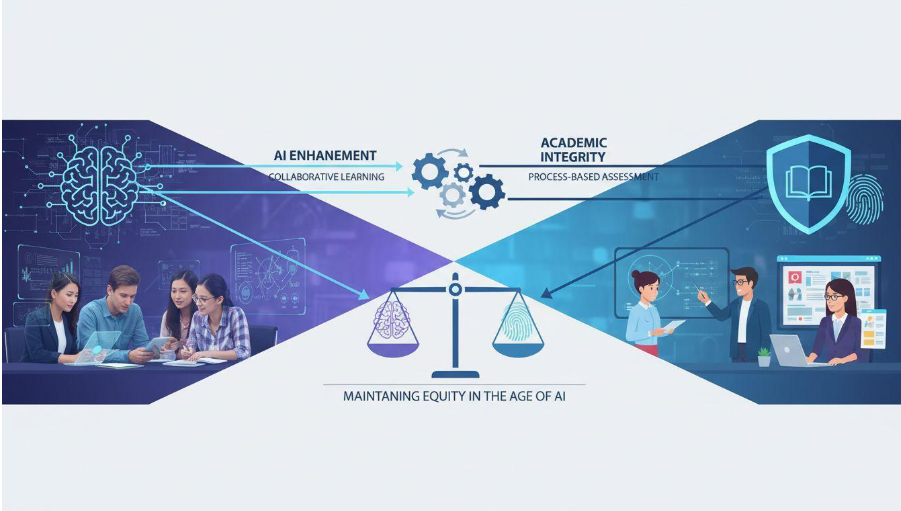
As AI-generated content becomes more prevalent in education, maintaining academic integrity has become increasingly complex. Students, teachers, and administrators are seeking reliable methods to identify AI involvement without disrupting learning workflows.
The Growing Role of AI in Academic Writing
Why AI Assistance Is Ubiquitous
Modern AI models like ChatGPT, GPT-4, and Claude are increasingly used for drafting essays, summarizing research, and generating study materials. This widespread adoption makes it challenging to differentiate between independent work and AI-assisted writing.
While AI can enhance productivity, it also introduces new risks for academic integrity.
Balancing Assistance and Authenticity
The challenge for educators is not simply banning AI tools. Many students rely on AI to organize their thoughts or draft ideas, which can be beneficial if used responsibly.
The question becomes: how do you allow productive AI use without compromising originality? This is where tools like an AI Detector play a crucial role.
How AI Detectors Work in an Academic Context
Identifying Patterns Beyond Vocabulary
Academic writing has unique characteristics, including logical progression, citations, and formal tone. AI-generated text can mimic these features convincingly, making surface-level checks insufficient.
An AI Detector focuses on deeper patterns such as sentence predictability, phrase repetition, and overall structure. These cues often reveal AI involvement even after light editing.
Supporting Educators’ Workflow
Rather than replacing teacher judgment, AI detectors provide a first layer of insight. Educators can quickly identify essays or reports that may require closer review. This reduces the burden of manual checking and helps maintain consistency across submissions.
Best Practices for Using AI Detectors in Schools
Integrating Detection Into Assessment
For optimal results, AI detection should be part of a structured assessment workflow. Teachers can use it to flag content for review rather than automatically penalizing students. This promotes fairness and transparency.
Focusing on Learning Outcomes
Detection is most effective when paired with discussions about writing skills and critical thinking. Educators can use flagged content as a teaching moment, showing students how to balance AI assistance with independent reasoning.
Encouraging Ethical AI Use
AI detectors also help set boundaries. By demonstrating which patterns are easily recognized, students learn how to use AI responsibly. Some institutions incorporate this guidance into academic integrity policies, reinforcing ethical standards.
Dechecker’s Role in Academic Integrity
Reliable Analysis Across Different Models
Dechecker supports multiple AI models, including ChatGPT, GPT-4, Claude, and Gemini. This ensures that educators are equipped to handle a wide range of AI-generated content.
Its AI Detector identifies both obvious and subtle AI signals, allowing schools to apply consistent evaluation criteria.
Providing Actionable Insights
Dechecker doesn’t just flag AI content—it highlights areas that may require attention. This enables targeted intervention rather than wholesale rejection, saving time for teachers and administrators.
Combining Detection With Refinement Tools
For assignments that involve AI-assisted drafting, tools like the AI Humanizer can help students improve readability and tone. When used alongside detection, this creates a feedback loop that promotes both learning and authenticity.
Challenges and Limitations
Not a Replacement for Educator Judgment
While AI detectors provide valuable insights, they should not be treated as infallible. Human review is essential to interpret results and understand context.
Balancing False Positives
AI detection is not perfect. Some original work may inadvertently resemble AI patterns, and some AI-assisted content may pass undetected. Schools must account for this variability when designing policies.
Staying Current With Evolving AI Models
As AI models improve, detection methods must adapt. Tools like Dechecker update regularly to keep pace with advancements, but ongoing vigilance remains necessary.
Implementing a Practical AI Detection Strategy
Combining Tools With Policy
Effective academic integrity strategies combine technology with clear guidelines. Detection tools provide data, but policies define how that data is used responsibly.
Encouraging Transparency With Students
Informing students about AI detection tools helps create a culture of honesty. It encourages them to disclose AI assistance when appropriate, while still leveraging AI for learning support.
Continuous Feedback and Improvement
Detection tools also support iterative improvement. By analyzing trends in AI-assisted submissions, educators can refine teaching methods and clarify expectations for students.
Final Thoughts
AI is transforming education, but maintaining integrity doesn’t require rejecting technology entirely. Dechecker offers a practical AI Detector that helps educators balance innovation with fairness.
By identifying subtle AI signals, providing actionable feedback, and supporting responsible AI use through complementary tools like the AI Humanizer, schools can foster a learning environment that values both efficiency and originality.