
Using a free prorated rent calculator takes the guesswork out of partial-month rent — whether you’re a tenant moving in mid-month or a landlord settling a final payment.
Here’s the quick answer on how prorated rent works:
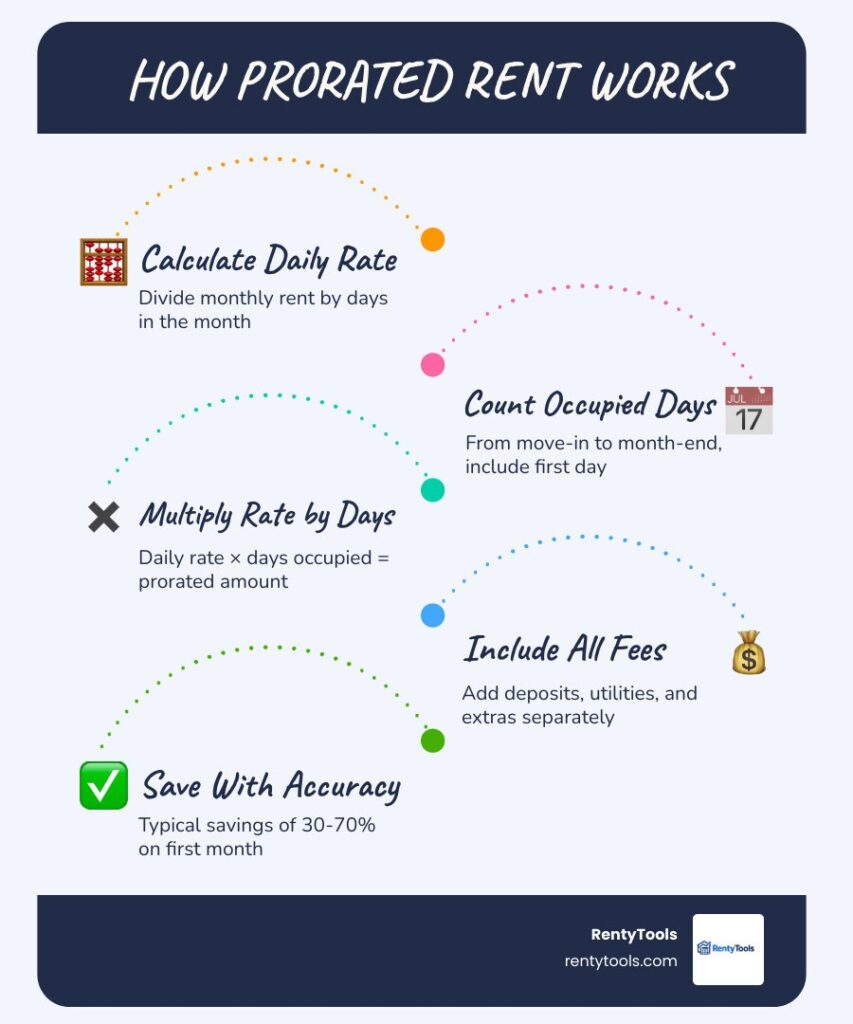
- Find your daily rent rate — Divide your monthly rent by the number of days in that month
- Count your occupied days — From your move-in (or move-out) date through the end (or start) of the month, including the first day
- Multiply — Daily rate × days occupied = your prorated rent
Example: $1,200 monthly rent ÷ 30 days = $40/day. Moving in on the 10th means 21 days occupied → $840 prorated rent.
In a perfect world, every tenant moves in on the 1st and out on the last day of the month. But real life rarely works that way.
The average prorated rent for a mid-month move comes out to around $993 (based on a ~$1,987 average monthly rent). That’s a significant amount — worth calculating correctly.
What is Prorated Rent and Why It Matters in May 2026

In the rental world, “prorated” is just a fancy way of saying “proportional.” When we prorate rent, we are dividing the total monthly charge based on the specific amount of time a tenant actually occupies the property. As we navigate the rental market in May 2026, this practice has become more than just a courtesy—it is a cornerstone of fair housing and professional property management.
For tenants, the benefit is obvious: Why Prorated Rent for the First Month Can Save You Real Money is a topic we discuss often because it represents a 30-70% typical savings compared to paying a full month for partial occupancy. If you move in on the 20th of a 30-day month, why should you pay for the 19 days the unit sat empty?
For landlords, offering prorated rent is a strategic move. It significantly reduces vacancy periods. Instead of forcing a tenant to wait until the 1st of the next month to move in, a landlord can fill the unit immediately on the 15th. This keeps the cash flowing and builds immediate rapport with the tenant. We have found that landlords who are flexible with move-in dates and use a free prorated rent calculator to provide transparent figures are far more likely to retain high-quality tenants long-term.
How to Use a Free Prorated Rent Calculator for Accuracy

While you can certainly do the math on a napkin, using a digital tool is the gold standard for avoiding human error. Our Prorated Rent Calculator is designed to handle the heavy lifting, ensuring that the daily rate is calculated with precision—often up to four decimal places—before rounding to the nearest cent.
Why Precision Matters
If you are dealing with a high-end rental where the rent is $4,000 a month, a small rounding error can actually result in a several-dollar difference. Most professional systems calculate the daily rate (e.g., $133.3333) and only round the final total. This ensures that the math remains “clean” across the entire billing cycle.
Factoring in Move-In Costs
A common mistake people make is thinking that prorated rent is the only thing due on move-in day. When using our tools, your initial payment usually consists of:
- The prorated rent amount.
- The full security deposit (which is typically based on a full month’s rent, not the prorated amount).
- Any applicable pet fees or parking fees.
- The first full month’s rent (depending on the landlord’s policy).
By using an automated free prorated rent calculator, you can generate a clear, itemized breakdown to share between landlord and tenant. This documentation prevents the “Wait, why is this so expensive?” conversation on moving day.
Common Methods and Legal Requirements for Proration
Not all proration is created equal. Depending on where you live or what your lease says, the “daily rate” might be calculated in three different ways.
1. The Actual Days Method (The Gold Standard)
This is the most common and, in our opinion, the fairest method. You divide the monthly rent by the actual number of days in that specific month (28, 29, 30, or 31).
- January: Rent ÷ 31
- June: Rent ÷ 30
- February 2026: Rent ÷ 28
2. The 30-Day Banker’s Month
Some landlords prefer consistency. They treat every month as if it has 30 days, regardless of the calendar. While simpler for accounting, it can lead to slight variations in the daily rate.
3. The Annual 365-Day Method
This method takes the total annual rent and divides it by 365 (or 366 in a leap year) to find a daily rate that never changes throughout the year.
MethodFormulaProsConsActual DaysRent / Days in MonthMost accurate/fairRate changes monthly30-Day MonthRent / 30ConsistentInaccurate for Feb/31-day monthsAnnual (365)(Rent x 12) / 365Stable daily rateCan be confusing to tenants
Legal Landscape in 2026
Does a landlord have to prorate? Interestingly, there is no federal law requiring it. However, the legal tide is turning.
- 3 states (including California) have specific laws that mandate or highly regulate how proration is handled in residential tenancies.
- In California, for example, tenants have specific protections regarding how rent is handled during the termination of a lease. You can explore more at the California Tenant Rights and Proration guide.
- In New York, the New York Real Property Law provides the framework for rent obligations, though much is still governed by the individual lease agreement.
Across all 50 states and DC, proration is considered the “industry standard.” Even if it isn’t strictly required by a specific statute in your state, a landlord refusing to prorate is often seen as a red flag by savvy renters.
Step-by-Step Guide: Calculating Move-In vs. Move-Out Rent
Calculating rent for the beginning of a lease is slightly different from calculating it for the end. Here is how we break it down.
The Move-In Formula
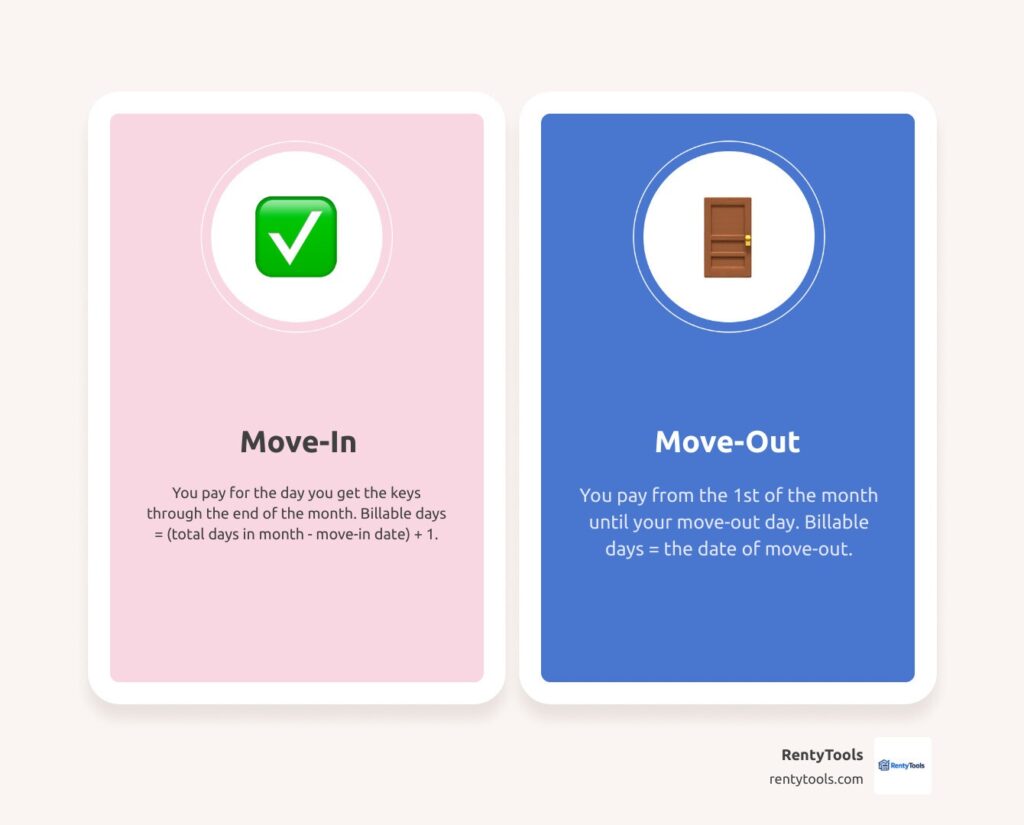
When you move in, you are paying for the day you get the keys through the end of the month.
- Determine Billable Days: (Total days in month – Move-in date) + 1.
- Calculate Daily Rate: Monthly Rent / Total days in month.
- Total: Daily Rate x Billable Days.
Example: Moving in May 15th. May has 31 days. (31 – 15) + 1 = 17 billable days.
The Move-Out Formula
When moving out, you are paying from the 1st of the month until your move-out day.
- Billable Days: Simply the date of move-out (if you move out on the 10th, you owe for 10 days).
- Calculate Daily Rate: Monthly Rent / Total days in month.
- Total: Daily Rate x Billable Days.
Important Occupancy Rules
We always tell our users: Count the move-in day. If you get the keys at 8:00 AM on the 15th, you occupied the unit on the 15th. Don’t skip that day in your math!
Documentation and Utilities
Once you have used our Rent Calculators, don’t just send a Venmo request. Put it in writing. A simple email or a “Lease Amendment” stating: “Prorated rent for May 15-31 is calculated at a daily rate of $X.XX for 17 days, totaling $Y.YY,” prevents 99% of future arguments.
Also, don’t forget utilities! If the landlord bills you for water or electricity, those should also be prorated based on the same number of days, unless there is a separate meter reading for your move-in date. If you’re worried about the total cost of moving, our Rent Affordability Calculator can help you see if the new place fits your 2026 budget.
Frequently Asked Questions about Prorated Rent
Is a free prorated rent calculator accurate for February?
Yes, provided it uses the Actual Days Method. February is the trickiest month because it is so short. For a $1,500 rental, the daily rate in February ($53.57) is significantly higher than in March ($48.39). A good free prorated rent calculator will automatically detect if it is a leap year and adjust the denominator to 28 or 29 accordingly. We always recommend using the actual days in the month to ensure neither the landlord nor the tenant is unfairly penalized by the calendar’s quirks.
Do landlords have to prorate rent by law?
In most states, there is no explicit statute that says “Landlords must prorate.” However, it is governed by the Lease Agreement. If the lease says rent is $2,000 per month and doesn’t mention proration, the landlord could technically demand the full amount. That said, in the competitive 2026 rental market, most landlords prorate to avoid having a vacant unit. If your landlord refuses, it is a great time to negotiate. Point out that the unit is empty anyway and that you are willing to start the lease early if they agree to a fair daily rate.
Can I use a free prorated rent calculator for move-out refunds?
Absolutely. If you have already paid your full month’s rent but end up moving out early (and the landlord has agreed to this in writing), you can use the calculator to determine your refund. This often happens in “lease break” scenarios where a new tenant is found mid-month. The landlord cannot “double dip” by collecting full rent from two different people for the same days. If you are splitting the final refund with roommates, our Rent Split Calculator is the perfect companion tool to ensure everyone gets their fair share back.
Conclusion
At RentyTools, we believe that financial transparency is the key to a stress-free rental experience. Moving is already one of the most stressful life events—calculating the rent shouldn’t add to that burden. By using a free prorated rent calculator, both landlords and tenants can enter into a lease agreement with confidence, knowing that the numbers are fair, accurate, and based on industry standards.
Whether you are moving into a new studio in the city or managing a portfolio of suburban homes, treat proration as a standard part of your financial toolkit. It builds trust, saves money, and ensures that everyone starts the landlord-tenant relationship on the right foot.
Ready to run the numbers? Head over to our Prorated Rent Calculator and get your exact total in seconds. Happy moving!